From Spreadsheet Chaos to a Modern Data Stack
A company I worked for operated multiple DTC furniture brands and acquired an app to reduce acquisition costs by recommending products from its own portfolio. The strategy was straightforward. The measurement was not.
The user journey crossed paid media, a mobile app, several ecommerce stores, and long conversion windows that often stretched weeks beyond the first interaction. Attribution signals came from everywhere — ad platforms, mobile measurement, MTA — and none of them agreed by default. At the same time, the reporting layer depended on a large spreadsheet fed by automation tools, connectors, Python scripts, and manual processes.
It worked, but barely. And more importantly, it wasn’t something the business could reason about with confidence.
I saw this as an opportunity not just to fix reporting for the app, but to set a new analytical standard the organization could build on. I rebuilt this system around a modern data stack with the warehouse at its core and business logic made explicit in the data model.
What changed structurally
- BigQuery became the single source of truth
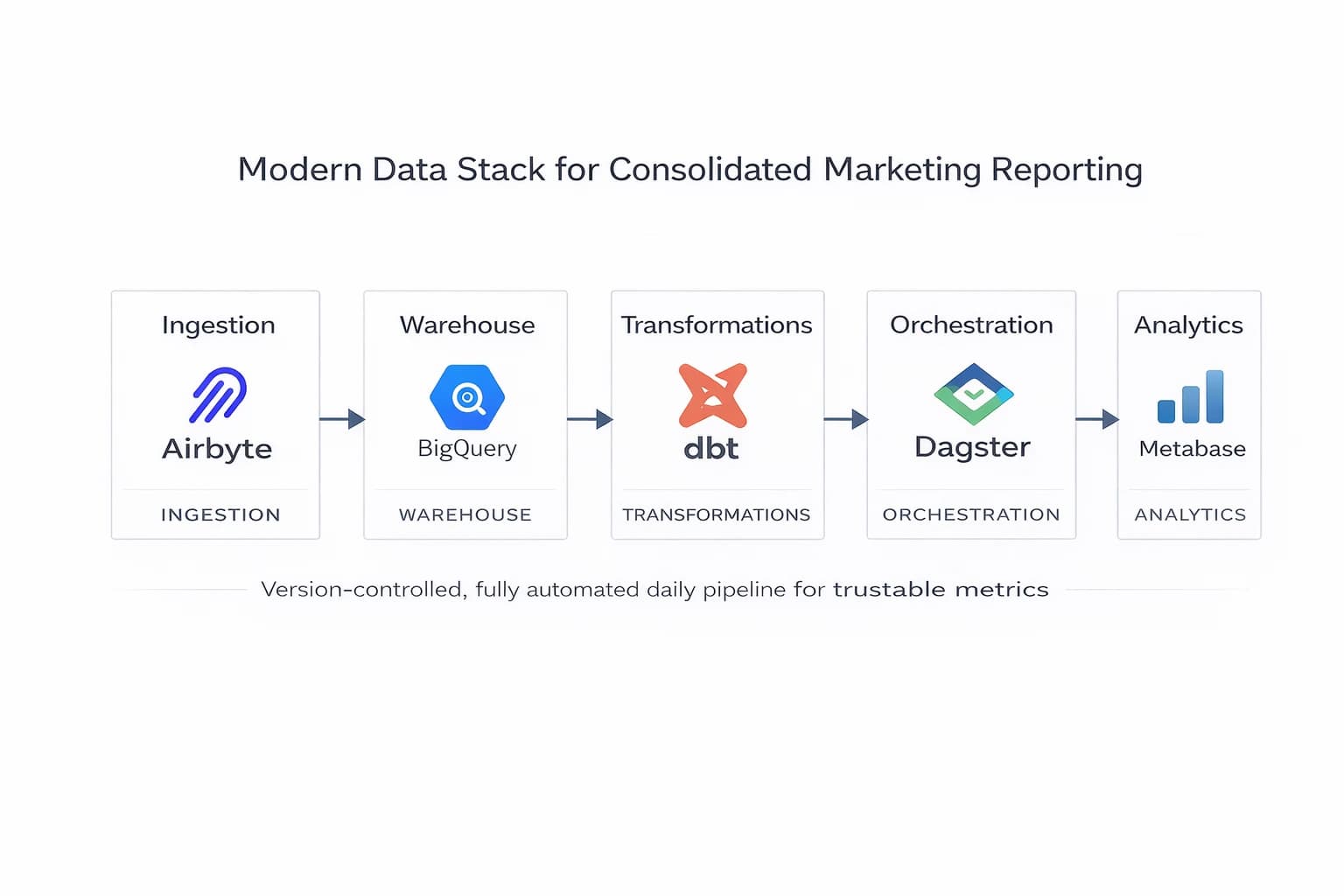
- Ingestion was standardized via Airbyte and orchestrated with Dagster
- All transformation logic was refactored into version controlled dbt models, replacing ad-hoc SQL and spreadsheet logic
- Metrics were defined once and reused everywhere
The big challange was the modeling: defining consistent business logic across eight platforms that each structure data differently, and making sure the consolidated view was trustworthy enough for leadership to make budget decisions on.
Data sources consolidated
The data model consolidated signals from:
- Paid media: Meta Ads, Google Ads, TikTok Ads
- Product and lifecycle data: Klaviyo (email, SMS, profiles)
- Mobile and app analytics: AppsFlyer (including SKAN), Mixpanel
- Web analytics and attribution: GA4, Polar Analytics
This allowed the dashboard layer to answer questions that previously required guesswork: what an install actually cost, how app-driven traffic behaved on the stores, how email engagement correlated with app usage, how long conversions took on average, and how much revenue could reasonably be attributed back to app exposure.
What Changed
Before: weekly manual data prep, numbers nobody fully trusted, and an inability to answer follow-up questions beyond what was pre-built in the dashboard.
After: automated daily refreshes, a single source of truth with version-controlled transformation logic, and a team that can self-serve queries without waiting on a pipeline update. Every definition lives in tested, documented SQL, not in someone's head. The leadership team now makes budget allocation decisions based on this data: which media channels drive the highest-quality installs, which product recommendation strategies convert into revenue, and whether the app is delivering the ROI it was acquired for.
This project required understanding paid media attribution, mobile app analytics, ecommerce conversion modeling, and the engineering to pipe it all together into something trustworthy and maintainable.